
What Are Dental Implants? Common Dental Implant Questions Answered

This extensive resource addresses common dental implant questions, such as determining what dental implants are, how they work, who can benefit from dental implants, and determining who can benefit from dental implants, understanding the distinctions between titanium and zirconia implants, and identifying the optimal candidates for this transformative procedure.
Delve into the details with us, as we unravel the nuances of dental implant options and guide you toward making informed decisions for a healthier and more confident smile.
What Are Dental Implants?

Dental implants are artificial root replacements for missing teeth that mimic the structure of natural teeth. Unlike traditional dentures or bridges, dental implants consist of three key components: a ceramic or titanium implant, an abutment, and a crown or bridge. The implant acts as a screw for the abutment and crown to attach to by being surgically placed into the jawbone, serving as a sturdy foundation for the replacement tooth.
Once the implant is placed, the jawbone gradually fuses with the ceramic or titanium post over a 12-week period, creating a strong and durable bond. This integration period ensures the implant becomes a seamless part of your jaw, mimicking the natural root of a tooth. While the implant remains protected under the gums during the healing process, the abutment sits slightly raised to act as a marker for the implant placement. Once the healing is complete, the abutment connects the post to the crown, completing the dental implant process.
How Do Dental Implants Work?
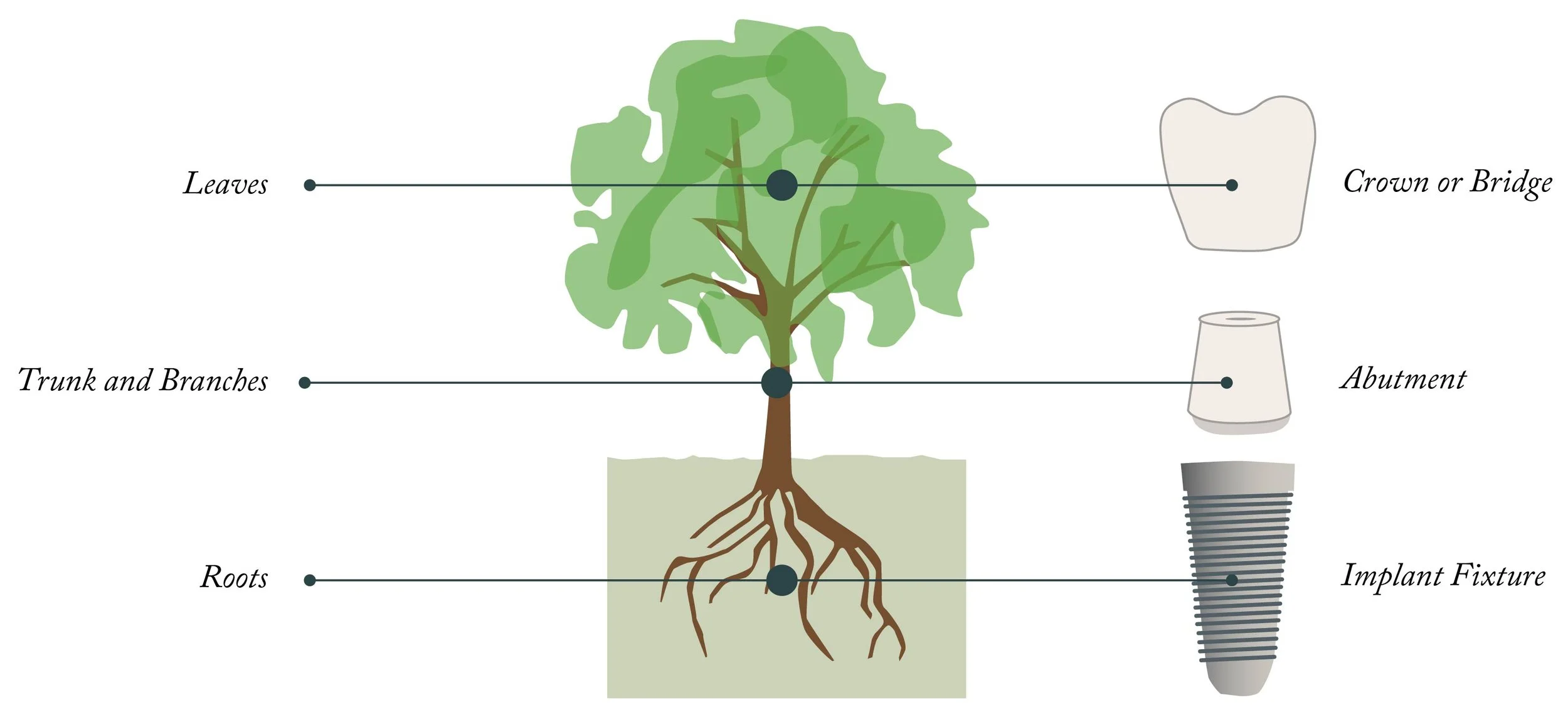
The typical dental implant consists of three main components:
Implant Fixture (Roots):
Comparable to the roots of a tree, the implant fixture is a ceramic or titanium post surgically implanted into the jawbone. This screw-like post has the remarkable ability to fuse with the bone through osseointegration, establishing a stable and durable foundation akin to a tree's roots in the soil.
Abutment (Trunk or Branches):
Acting as the trunk or branches rising above the forest floor, the abutment serves as a connector piece attached to the implant fixture. This component extends above the gum line, playing a pivotal role in linking the implant roots to the visible portion of the dental implant.
Crown or Bridge (Leaves):
Much like the leaves of a tree contribute to its unique identity, the prosthetic element of the dental implant consists of the crown, bridge, or denture. Custom-made to match the natural teeth in color, shape, and size, the prosthetic ensures a seamless integration, enhancing the natural appearance of the implant.
Types of Dental Implants:
Dr. Farkas prioritizes patient safety and optimal treatment outcomes above all else, as a result he chooses not to place Subperiosteal and Zygomatic implants due to their associated risks and complexities. While these types of implants may be suitable for certain cases, Dr. Farkas believes in offering procedures with the highest success rates and lowest risk profiles for his patients. By focusing on proven techniques and materials, he ensures that each patient receives the most reliable and effective treatment possible, aligning with his dedication to providing exceptional holistic dental care at Smile Montecito.
-
Endosteal implants are the gold standard in tooth replacement, offering a strong and durable solution. Endosteal implants are surgically placed directly into the jawbone, providing a robust foundation for your replacement teeth
-
For those with insufficient bone height for traditional implants subperiosteal implants might be an alternative solution. This implant sits on top of the jawbone but beneath the gum tissue, eliminating the need for extensive bone grafting.
-
When traditional implant options are not feasible due to bone loss, zygomatic implants may be an advanced alternative. These implants anchor into the zygomatic (cheek) bone, offering a foundation for a full arch restoration.
Who Needs Dental Implants?
Dental implants are a viable solution for individuals facing tooth loss due to various reasons. Whether the loss is a result of trauma, dental decay, gum disease, or congenital conditions, dental implants offer a stable and functional replacement.
Beyond functionality, dental implants contribute to the preservation of the jaw bone by providing stimulation similar to natural tooth roots, preventing bone loss and maintaining facial structure.
Dental implants are an excellent option for individuals who:
Desire a long-term, permanent solution for missing teeth (single, multiple, full-arch)
Seek improved oral function and stability
Wish to restore their smile and self-confidence
Dental implants are the long-term solution for a range of scenarios:

-
Single Tooth Replacement:
For individuals who need to replace a single missing tooth without affecting neighboring teeth.A single-tooth implant consists of a ceramic or titanium post anchored into the jawbone, topped with a customized dental crown. The result is a natural-looking and fully functional replacement that seamlessly integrates with the surrounding teeth.
-
Multiple Tooth Replacement: For individuals with multiple adjacent missing teeth, implants can be used to support bridges, replacing several missing teeth.
Implant-supported bridges utilize dental implants strategically placed in the jaw to support a customized bridge. This provides a stable and durable solution for restoring a section of missing teeth, improving both function and aesthetics.
-
Missing All Teeth?
Full Arch Replacement: For individuals missing all their teeth, implant-supported dentures provide a secure and comfortable alternative to traditional dentures.All-on-X:
Commonly known as All-on-4, a solution for full arch tooth replacement, using only four strategically placed implants to support an entire set of teeth. Dental implants act as anchors for the denture, preventing slippage and providing enhanced stability, comfort, and chewing efficiency.
What are the Benefits of Dental Implants?
Enhancing Aesthetic and Natural Appearance
The use of cutting-edge technology in Smile Montecito's practice guarantees precision in implant placement, resulting in a natural appearance that boosts patients' confidence and self-esteem. Through this holistic approach, the aesthetics of the smile are considered in conjunction with the patient's unique facial features, fostering a harmonious and natural-looking outcome.
Restoring Functionality for Eating and Speaking
The stability of dental implants allows patients to regain full biting force and functionality, enabling them to enjoy a diverse diet and enhance their overall confidence. This ensures that patients experience a transformative improvement in their ability to eat, speak, and engage in daily activities with comfort and ease.
Boosting Psychological and Emotional Well-being
Smile Montecito's holistic approach places a strong emphasis on the connection between oral health and overall quality of life. By restoring a complete and beautiful smile through dental implants, patients often experience a boost in self-confidence and a positive shift in their emotional well-being. Dr. Farkas understands the psychological impact of tooth loss and aims to provide compassionate care that addresses not only the functional aspects of dental implants but also the emotional aspects.

How Long is the Recovery Time for Dental Implants?
Following dental implant surgery, it's crucial to adhere to specific guidelines to support optimal healing. Dr. Farkas’ goal is to restore the function and confidence of your smile within 6-months. However, your commitment to both the physical and mental aspects of recovery significantly influences the ultimate recovery time of the dental implant process. Patients should follow the post-surgery care instructions and prescribed medications, including antibiotics and pain relievers, as directed.

What Does Immediate Loading Mean in Dental Implantology?
Immediate loading in dental implantology refers to a technique where a dental prosthesis (such as a crown, bridge, or denture) is attached to the dental implants shortly after they are surgically placed, typically within 48 hours. This approach allows patients to leave the dental office with a fully functional set of teeth on the same day as the implant surgery, rather than waiting for the 3-6 month healing period before receiving their final restoration.
The success of immediate loading depends on various factors, including proper case selection, careful surgical technique, and meticulous prosthetic design. While immediate loading offers the advantage of immediate function and aesthetics, it also carries some risks, such as implant failure due to premature loading or compromised osseointegration.